Method
Know what to work on after every practice session
Practice exam topics with original questions, understand the answers with Alex, your AI tutor, and revisit mistakes with automatic review cards. Your domain results and readiness score help you choose what to study next.
Practice in Pass-IT
Turn your answers into focused revision

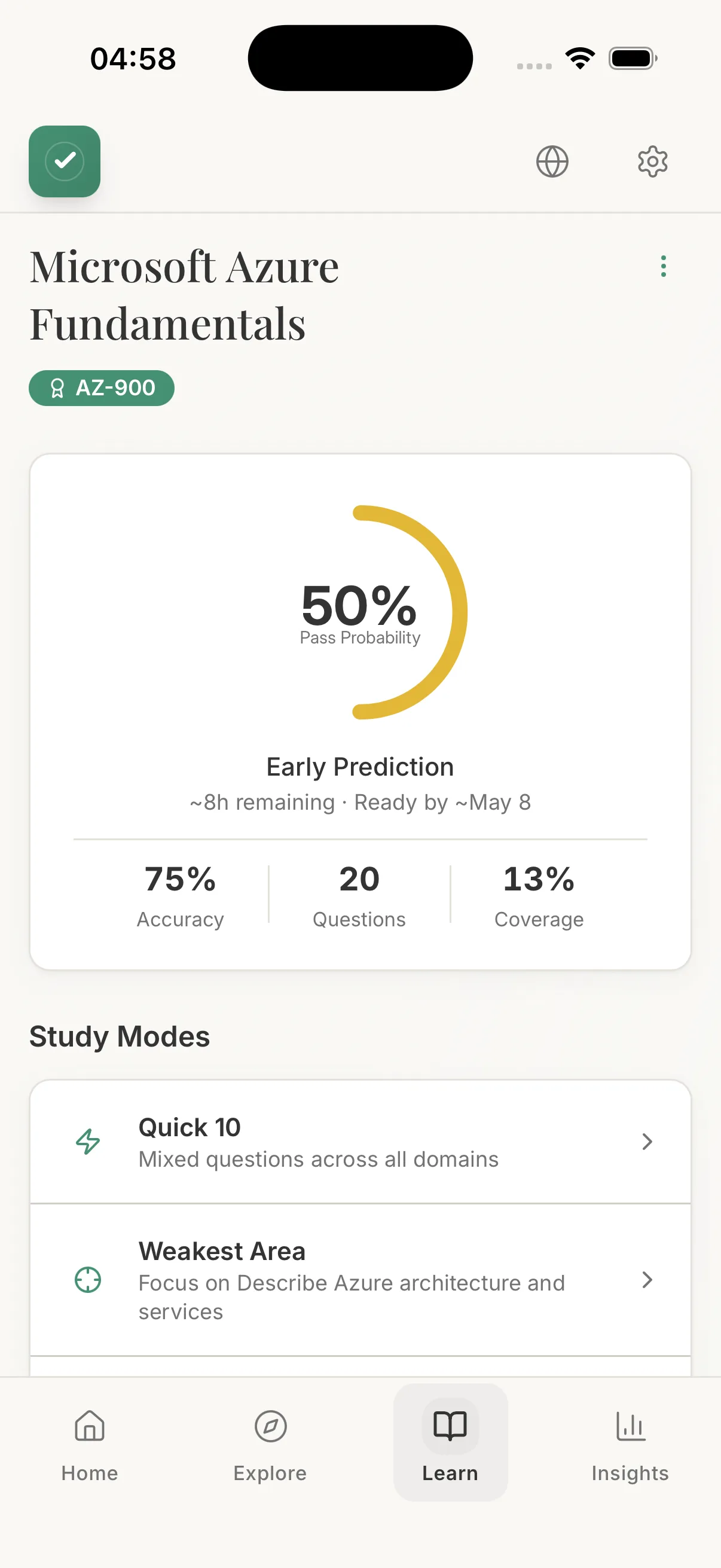
See which domains need more attention
Your domain performance helps you choose your next study topic. The readiness score brings together domain-weighted performance and practice coverage to summarize your preparation so far.
- 1See which domains need more attentionYour domain performance helps you choose your next study topic. The readiness score brings together domain-weighted performance and practice coverage to summarize your preparation so far.
- Ask Alex until the reasoning is clear. Alex, your AI tutor, explains answers and responds to follow-up questions in five languages. It searches official documentation and provides citations when available, helping you explore why an answer fits and why alternatives do not.
- Get review cards for your mistakes. Incorrectly answered questions automatically become review cards, scheduled for future sessions. You can revisit the reasoning without creating the cards yourself.
The research
Evidence for practice testing and spacing
The review by Dunlosky and colleagues (2013), linked below, rates practice testing and distributed practice highly. Its findings concern these learning techniques, rather than the effectiveness of Pass-IT or the predictive accuracy of its readiness score.
- Try answering before checking. Practice testing asks you to recall or apply what you have learned before looking at the answer. Dunlosky and colleagues rated this technique highly in their review. You can use it alongside reading: study an idea, attempt a question, and check where your reasoning needs work. Read the review →
- Use feedback to examine your reasoning. After answering, compare the explanation with the reason you chose your answer. Identify the concept or condition you missed, then try applying it to another example. Related meta-analysis on practice testing →
- Return to material over time. Distributed practice means revisiting material across separate study sessions. Dunlosky and colleagues also rated this approach highly. Plan opportunities to return to a topic, attempt it again, and use the result to decide whether you need further review.
FAQ
Frequently asked questions
What exactly is the readiness score?
It is a metric based on your practice that combines domain-weighted performance and topic coverage. No readiness score appears before 20 responses. From 20–49 responses, it is capped at 70%; from 50 responses, the full range is available. These display rules help you interpret your practice feedback; the score is not a validated probability of passing the official exam.
What is the difference between learning research, practice results, and exam outcomes?
Learning research studies techniques such as practice testing and spacing. Your Pass-IT results describe your answers within the product and help you choose what to review. Official exam outcomes show whether someone passed the exam. Each answers a different question about learning or performance.
What does the cited research support?
Dunlosky and colleagues (2013) rate practice testing and distributed practice highly. That supports including these techniques in a study routine. The review evaluates learning techniques, not Pass-IT’s effectiveness, explanations, or readiness score.
Do I have to create the review cards myself?
No. The review system adds cards for incorrectly answered questions and schedules future reviews. The intervals adjust as you continue, with successful repetitions leading to longer intervals. Return to the scheduled reviews to work through the questions again.
Try the method in a free practice session
Answer your first questions, explore the explanations, and see what needs more attention. Your first practice session is free, with no card required.
Start practicing free